
Here’s an inconvenient truth about a certain kind of very smart student: the ones who get stuck are often the ones who are used to being right. So when they hit a hard question, instead of moving on, they dig in — determined to solve it through sheer will, like the test is a matter of honor.
It isn’t. It’s a matter of time management, and the test doesn’t care how badly you wanted to beat that one geometry problem.
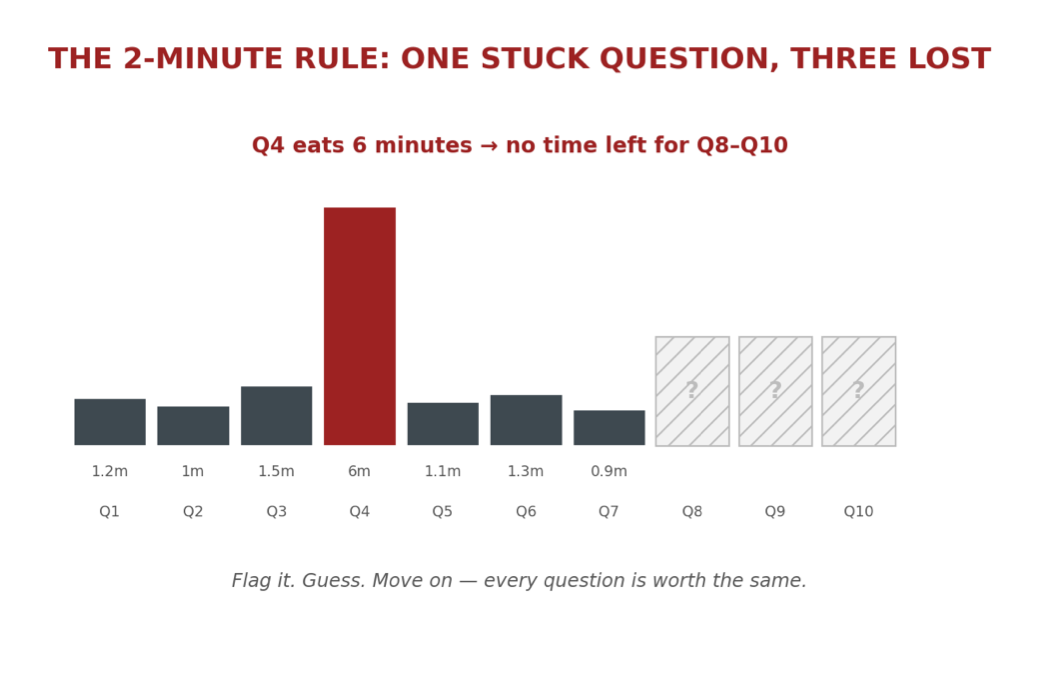
Here’s the rule I give every student: if a question isn’t cracking within about two minutes, flag it, take your best educated guess, and move on. Every question is worth exactly the same amount, whether it takes you fifteen seconds or five minutes. Spending six minutes proving you’re stubborn costs you three other questions you would have gotten right easily.
Let’s make that concrete, because “costs you points” is easy to say and easy to wave away. A typical math module has around 22 questions in roughly 35 minutes — call it a minute and a half per question on average, with easier ones taking less and harder ones taking more. A student who burns six minutes on one stubborn question has just spent the time budget of four questions on one. If the section ends and three easy questions at the back never get looked at, that’s not a knowledge failure. That’s a clock failure, and it’s completely avoidable.
This is one of those pieces of advice that sounds obvious once you hear it and is somehow never obvious in the moment, under a clock, mid-test. Students know it intellectually and abandon it completely under pressure — which is exactly why it has to be practiced, not just explained. I don’t just tell students the two-minute rule; we drill it under timed conditions until walking away from a hard question feels like strategy instead of defeat. The first few times, it feels almost wrong — like giving up. That feeling fades once a student sees their score go up because of it.
There’s a subtler version of this problem worth naming too: some students don’t get visibly stuck, they just work everything at the same careful, deliberate pace regardless of difficulty — which means the easy questions take longer than they need to, eating into time that should be reserved for the genuinely hard ones. The two-minute rule isn’t only about abandoning hard questions. It’s also permission to move fast through the easy ones without triple-checking each one out of habit.
Parents: if your kid comes home from a practice test saying they “ran out of time,” ask what happened on the last five questions. Nine times out of ten, the honest answer is that one or two early questions ate the clock. Fixing that isn’t about getting smarter. It’s about getting less stubborn — which, coincidentally, is a skill that ages very well, well past this particular test.
Do’s and Don’ts
| DO: Set an internal two-minute cap on any single question, and actually track it during practice tests with a stopwatch or the built-in timer.Flag a hard question, guess your best answer, and move on — you can return to it if time allows at the end.Move quickly and confidently through questions you find easy; don’t spend extra time re-checking answers you’re already sure of.Practice the rule specifically, not just generally — run timed drills where the goal is explicitly to notice and abandon a stuck question. | DON’T: Don’t treat a hard question as a personal challenge to be won at any cost.Don’t leave a question blank — an educated guess before moving on is almost always better than nothing.Don’t wait until test day to try this strategy for the first time; it needs practice under real timed conditions first.Don’t assume a slow, careful pace on easy questions is “being thorough” — on a timed test, it’s usually just a hidden cost. |
Dr. Hurwitz’ Take
I’ve watched more points lost to stubbornness than to actual lack of knowledge, and that’s not an exaggeration for effect — it’s just what shows up in the data when I review a missed section with a student. The kids who struggle most with this rule tend to be the ones who’ve never really been taught that walking away from a problem is a strategy rather than a failure. Once that clicks, it’s one of the fastest score gains I know how to produce, because it doesn’t require learning anything new. It just requires unlearning one bad instinct.
Pacing problems are some of the fastest fixes in tutoring. Reach out directly or comment PLAN for the free study plan that builds this in from week one.