
Every fall, I get some version of the same email: “My kid took a practice test and got an 1180. Is that… bad?” I never answer that question directly, because it’s the wrong question. The right question is: what’s actually recoverable, and how fast?
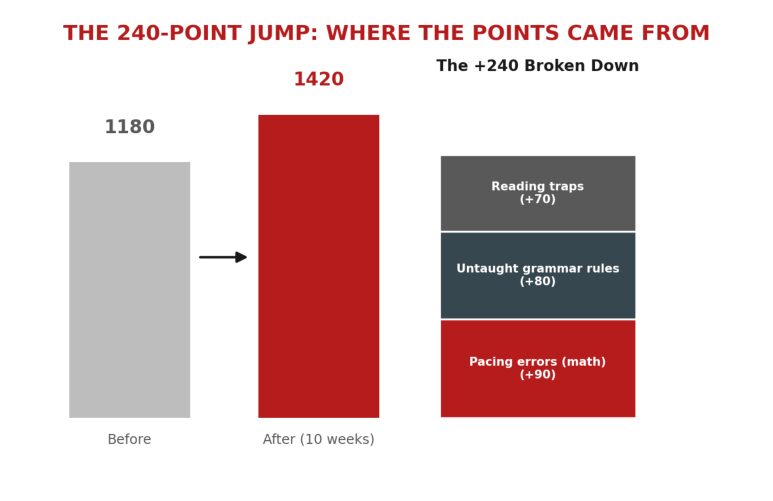
Here’s a real one. Ten weeks, one student, 1180 to 1420. I’d love to tell you it was some secret formula I keep in a locked drawer. It wasn’t. It was a diagnostic test that told us exactly which skills were costing points, a weekly plan built around those specific gaps instead of “more practice in general,” and enough timed, realistic practice that test day felt like just another Tuesday.
That’s the whole trick. There isn’t a bigger one.
Let me get more specific about what the diagnostic actually found, because “we identified the gaps” is the kind of vague phrase that sounds good and tells you nothing. In this student’s case, the diagnostic broke down into three concrete buckets: about 90 points sitting in careless pacing errors on math — not knowledge gaps, just rushing through easy problems and running out of time on later ones. Another 80 points in a handful of recurring grammar rules that showed up eight or nine times across the test but had never been explicitly taught. And the rest scattered across reading comprehension trap answers — the kind where a student picks something true instead of something relevant, which I’ve written about separately because it deserves its own explanation.
None of those three things required raw intelligence to fix. They required someone to point at them specifically and then build ten weeks of practice that targeted exactly those three things, in roughly that order of priority, instead of a generic “review everything a little” curriculum that would have wasted half the available time on skills that weren’t actually broken.
Parents are sometimes disappointed by how unglamorous this is. I understand — “structured, targeted repetition” doesn’t sound like it belongs on a highlight reel. But scores don’t move because a tutor is charismatic. They move because a student stops guessing at what to study and starts working on the three or four things that are actually holding the number down.
The diagnostic matters more than people think. Most students who come to me haven’t taken a full, timed, realistic practice test — they’ve done scattered problem sets, which tell you almost nothing about where the real bleeding is happening. A proper diagnostic is closer to a doctor ordering bloodwork before guessing at a prescription. You wouldn’t want a doctor treating a symptom without knowing the cause, and there’s no good reason to treat a test score any differently.
The ten weeks themselves weren’t evenly split. The first two were almost entirely diagnostic and foundation-setting — slower than parents expect, and usually the point where a family gets a little nervous because the score hasn’t moved yet. Weeks three through eight were where the real gains compounded, because that’s when the targeted skills started showing up correctly under timed conditions instead of just in isolated drills. The final two weeks shifted almost entirely to full-length, timed practice tests — not new content, just repetition under real conditions, so test day itself had nothing left to be unfamiliar.
If you’re staring at a first practice score wondering whether ten weeks is enough time to move it, in most cases, it is — assuming the ten weeks are actually structured. “More time studying” and “more effective time studying” are not the same thing, and the gap between them is usually the entire story.
Do’s and Don’ts
| DO: Take one full, timed, realistic diagnostic test before writing any study plan — not a handful of scattered practice problems.Break the diagnostic results into specific, named skill gaps (pacing, a grammar rule, a reading trap pattern) instead of a vague overall percentage.Expect the first two weeks to feel slow — foundation-setting doesn’t show up on a scoreboard yet, and that’s normal.Retake a full practice test periodically to confirm the targeted gaps are actually closing, not just assumed to be.Save the last two weeks almost entirely for full-length timed practice, not new content. | DON’T: Don’t judge a plan’s progress by hours logged instead of skills closed.Don’t skip the diagnostic to “save time” — it almost always costs more time than it saves.Don’t panic if the score hasn’t moved in week two. Check whether the targeted skills are improving, not the total score.Don’t switch strategies mid-cycle based on a single off practice test — look for a pattern across two or three before changing course. |
Dr. Hurwitz’ Take
I’ve had this conversation enough times to know exactly where it goes sideways: a parent hears “240 points” and starts imagining a specific technique they can ask me for by name. There isn’t one. What there is, every single time, is the same three-part process — diagnose specifically, target relentlessly, practice realistically — applied to whatever that particular student’s specific gaps turn out to be. It’s not exciting. It’s also the only version of this that has ever actually worked for anyone I’ve tutored, and I’ve stopped apologizing for how ordinary that sounds.
Curious what a real diagnostic would find in your student’s practice score? Reach out — happy to walk through it.