
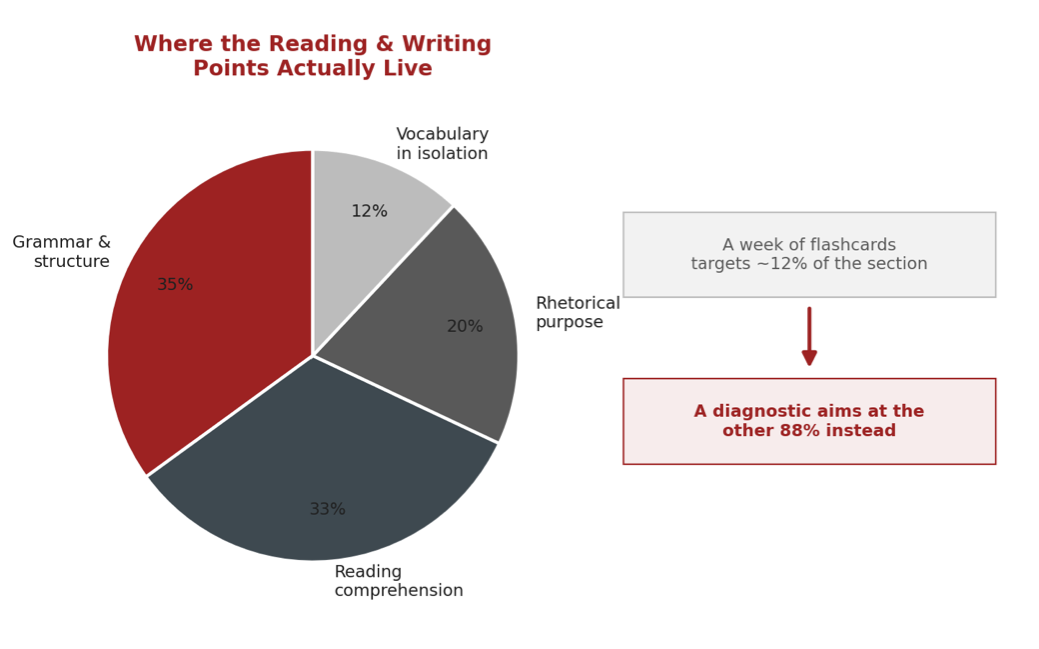
I want to gently retire a habit I see constantly: the student who spends a week memorizing vocabulary flashcards for a test that is, structurally, mostly reading comprehension and grammar.
It’s not that vocabulary is useless. It’s that it’s a rounding error compared to the actual point sources on the test, and a week is a finite resource. Spending it on the wrong thing doesn’t just fail to help — it actively costs you the week you could have spent on what’s actually tested.
This happens because studying “in general” feels productive. Flashcards are tidy. They have a clear start and finish. You can watch a stack get smaller and feel like you’re doing something. Reworking grammar rules or practicing reading-comprehension pacing is messier and less satisfying in the moment — which is exactly why students avoid it in favor of something that feels more like progress.
There’s a specific psychological trap here worth naming: flashcards give constant, small hits of completion — flip a card, know it or don’t, move to the next one. That rhythm is satisfying in a way that grinding through a genuinely hard grammar concept or a slow, careful reading passage isn’t. But satisfying and effective are different axes entirely, and a study plan built around what feels good in the moment tends to drift toward the wrong activities without anyone noticing, because nothing about it feels like a mistake while it’s happening.
To put a number on it: on the current digital SAT’s Reading and Writing section, direct vocabulary-in-isolation knowledge affects a relatively small slice of questions, most of which test a word’s meaning in context rather than a cold definition — which means a huge stack of memorized definitions doesn’t transfer nearly as well as students expect. Meanwhile, grammar and structure questions, along with reading comprehension and rhetorical-purpose questions, make up the large majority of that section. If a student has, say, five hours a week to study, spending three of them on flashcards for a skill that touches a small fraction of the questions is a straightforward math problem, not a matter of opinion.
This is the entire argument for a real diagnostic before a study plan gets written. Not because diagnostics are impressive, but because they’re the only way to know, with any confidence, what the actual highest-value use of a study week is for a specific student. Two students with the same overall score can have completely different weak spots, and the “study everything a little” approach wastes time on both of them.
If your kid has been quietly grinding through generic prep materials for weeks and the score hasn’t moved much, this is usually why. Not lack of effort — misallocated effort. The fix isn’t more hours. It’s aiming the hours somewhere they actually count.
Do’s and Don’ts
| DO: Get a diagnostic that tells you specifically where the points are before deciding what to study.Prioritize grammar rules, reading strategy, and pacing — the categories that make up the large majority of the Reading and Writing section.Practice vocabulary in context (within a passage) rather than as isolated flashcard definitions, if you study it at all.Reassess weekly whether study time is actually going toward the skills the diagnostic flagged, not just toward whatever feels productive. | DON’T: Don’t default to vocabulary flashcards just because they feel like tidy, measurable progress.Don’t assume “studying more” is the same as “studying the right thing.”Don’t spread study time evenly across every possible topic — that wastes time on things that were never actually broken.Don’t judge a study session’s value by how satisfying it felt in the moment. |
Dr. Hurwitz’ Take
If I had a dollar for every stack of vocabulary flashcards I’ve seen a well-meaning, hardworking student carry into a first session, I could probably cover a semester of tutoring for free. It’s not a knock on the kid — it’s exactly what you’d expect someone to do without a diagnostic pointing them somewhere more useful. The frustrating part is watching genuine effort get spent on the wrong target. The good part is that it’s an easy fix, once someone actually looks at where the real gaps are instead of guessing.
Not sure where your student’s hours should actually go? A diagnostic answers that in one sitting. Reach out to schedule one.