
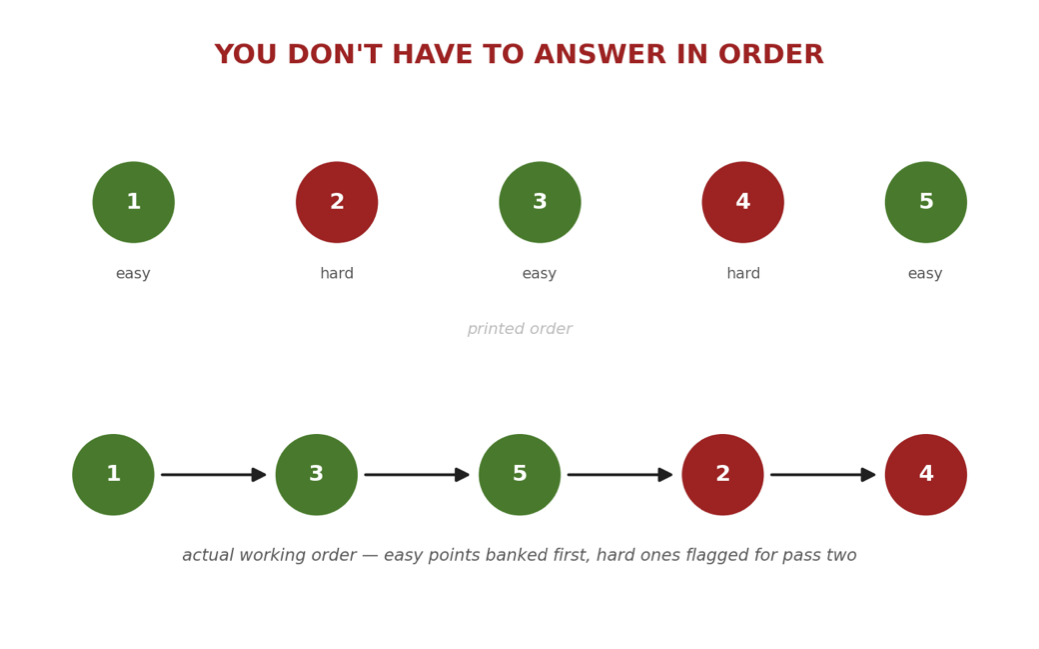
Somewhere along the way, a lot of students absorb the idea that a test has to be taken the way it’s printed — question one, then two, then three, obediently, like it’s rude to skip ahead. It isn’t rude. It’s not even against the rules. And ignoring that order is one of the easiest, least-talked-about ways to protect a score.
Within a section, you can work the questions you’re confident about first, bank those points fast, and circle back to the harder ones with whatever time is left. This sounds almost too simple to be real advice, and yet most students have never tried it, because nobody ever told them they were allowed to.
The benefit isn’t really about time saved. It’s psychological. A student who opens a section and immediately hits a brutal question three minutes in starts the whole section rattled — even if question four is easy. A student who skips ahead, grabs the easy points first, and builds a little momentum approaches the hard stuff calmer, because the pressure of “I need this one to keep my pace” is gone.
There’s a real physiological piece to this that doesn’t get discussed enough. Test anxiety compounds — one hard question that eats into your confidence makes the next question feel harder than it actually is, even if it’s objectively easy, because your working memory is partly occupied by residual stress from the last one. Banking a string of easy wins early does the opposite: each small success makes the next question a little easier to approach calmly. It’s not just time management. It’s mood management, and mood affects performance more than most students realize until they’ve felt the difference directly.
This is the kind of adjustment that costs nothing to try and takes about one practice test to master. I have students test it out explicitly — work a section out of order on purpose, just to feel what it’s like — because reading about a strategy and having actually done it under a clock are very different levels of confidence. On the digital SAT specifically, this is made easier by the built-in “mark for review” and question-navigator tools, which let a student flag a hard question and jump straight back to it later without losing their place — a feature a lot of students don’t realize exists until someone shows them.
A quick word on how to actually do this without creating chaos: I don’t recommend hunting randomly through a section looking for easy questions. The better version is a single, deliberate first pass — answer anything that resolves quickly and confidently, flag anything that doesn’t, and keep moving forward. Then a second pass through only the flagged questions once the first pass is done. Two clean passes, not an unstructured scramble.
If your student is the type to freeze on a hard problem instead of skipping it, this single habit might be worth more than another week of content review.
Do’s and Don’ts
| DO: Make one clean first pass through a section, answering anything that resolves quickly and flagging anything that doesn’t.Use the digital SAT’s “mark for review” and question navigator tools — they’re built for exactly this strategy.Do a single, focused second pass through only the flagged questions once the first pass is complete.Practice this explicitly at least once before test day so it feels familiar, not improvised. | DON’T: Don’t scan randomly back and forth through a section hunting for easy questions — that wastes more time than it saves.Don’t feel obligated to answer questions strictly in the order they appear.Don’t let a difficult early question set the emotional tone for the rest of the section — flag it and move forward.Don’t try this strategy for the first time on test day; it needs at least one practice run beforehand. |
Dr. Hurwitz’ Take
This is one of my favorite pieces of advice to give, honestly, because it’s almost embarrassingly simple and the reaction is nearly always the same: a slightly stunned “wait, I’m allowed to do that?” Yes. You were always allowed to do that. Nobody tells you, because the test is printed in a straight numbered line and it looks like an instruction even though it isn’t one. Once a student sees that the order was never a rule to begin with, a lot of the anxiety around “what if I hit a hard one early” just quietly goes away.
Small habits like this one are baked into our free 12-week study plan. Contact me directly or comment PLAN to grab it.