
This is one of the more thoughtful objections I get, and I never want to talk a parent out of the instinct behind it. Kids are genuinely overloaded — sports, clubs, homework, college essays, a social life they’re entitled to have. Adding something else is a real cost, and it’s reasonable to weigh it carefully.
Here’s what I’ve noticed, though, having watched a lot of students go through this: unstructured test prep anxiety takes up more mental space than structured test prep does. A kid who’s vaguely worried about the SAT, who knows they should be doing something but doesn’t know what, carries that low-grade dread around constantly — it shows up at random moments, unscheduled, uninvited. A kid with a clear weekly plan knows exactly what Tuesday looks like, does it, and then the SAT is off their mind until next Tuesday.
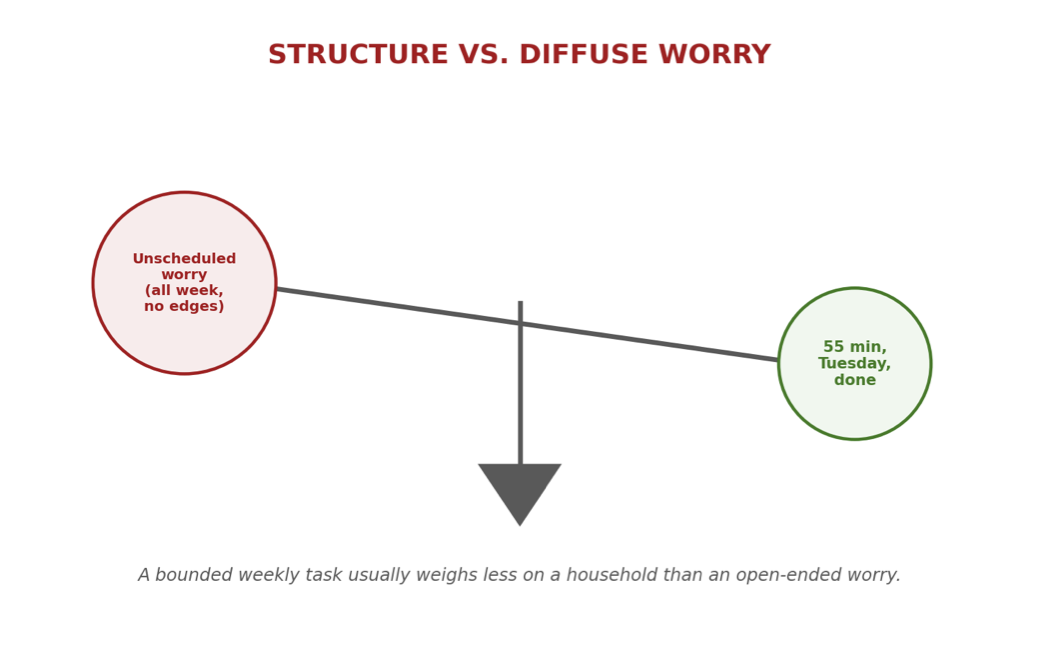
I think of it as the difference between a scheduled expense and an open-ended one. An open-ended worry doesn’t have edges — it can surface during a car ride, at dinner, right before bed, anytime the mind wanders toward “I should probably be doing something about that test.” A scheduled commitment has edges. It happens Tuesday at 4 PM for 55 minutes, with a specific homework task attached, and then it’s genuinely closed until next week. Most students, and honestly most adults, find bounded tasks far less draining than open-ended ones, even when the bounded task takes real time and the open-ended one technically takes none.
So the honest comparison isn’t “tutoring versus nothing.” It’s “tutoring versus the diffuse anxiety that’s already there whether or not there’s a plan attached to it.” Structure tends to reduce the total mental load, not add to it, because it replaces an open-ended worry with a bounded task.
That said — fit matters, and I want to be specific about what “fit” actually means rather than just asserting it. One weekly 55-minute session with clear, contained homework is a very different commitment than daily prep, and it’s worth asking directly how much homework a specific plan actually expects between sessions — an hour a week looks very different on an already-packed schedule than three or four hours would. I always calibrate to what a specific student’s schedule can actually absorb, and I’d rather scale back the plan than have it become one more source of pressure in an already full week.
The goal was never to add stress. If a plan is adding stress instead of replacing it, that plan is wrong, and it should change. That’s a conversation worth having before assuming the whole idea is off the table — and it’s a conversation worth revisiting a few weeks in, too, not just at the start.
Do’s and Don’ts
| DO: Ask directly how much homework a plan expects between sessions before committing to it.Weigh the diffuse, unscheduled anxiety of an unaddressed test date against the bounded time cost of a structured plan.Revisit the workload a few weeks in, not just at the outset, and adjust if it’s becoming too much.Look for a plan that scales to what the student’s actual schedule can absorb, rather than a one-size-fits-all commitment. | DON’T: Don’t assume tutoring automatically means added stress — compare it honestly against the stress that’s already there without a plan.Don’t sign up for a plan without asking about the real between-session time commitment.Don’t let a plan that’s genuinely become too much continue unchanged out of a sense of obligation.Don’t confuse “structure” with “more work overall” — often it’s the same amount of worry, just organized instead of scattered. |
Dr. Hurwitz’ Take
I take this objection seriously every time I hear it, because it usually comes from a parent who’s genuinely trying to protect their kid rather than one who’s just looking for an excuse. What I try to do in that conversation is make the actual trade-off visible — not “tutoring versus a light, worry-free schedule,” because that second option usually isn’t the real alternative on the table. The real alternative is often a kid quietly stressed about an approaching test with no plan attached to that stress at all, which is its own kind of load, just an invisible one.
If schedule is the real concern, let’s talk about what actually fits before deciding it doesn’t.