
People tend to think about test scores in terms of admissions odds, which is fair — but there’s a second number attached to a lot of scores that gets talked about far less: merit aid.
A meaningful number of colleges set merit scholarship thresholds at specific score cutoffs. Cross one, and the award changes — sometimes by a few thousand dollars, sometimes by a lot more, and often for all four years, not just one. That means a score increase isn’t just a stronger application; in a lot of cases, it’s a direct, calculable return on the time and cost of test prep, separate entirely from where a student ends up getting in.
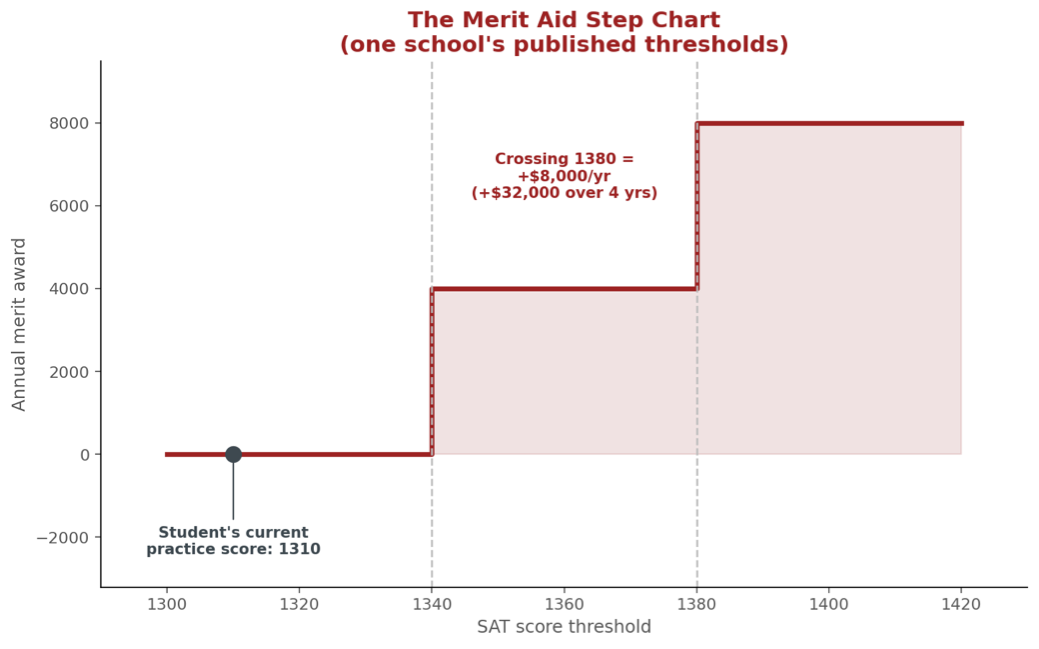
Here’s how to actually run this math for your own family, because “it’s worth checking” is less useful than knowing what to check. Start with each school on your list’s published automatic merit scholarship chart, if one exists — many public universities and a good number of private ones publish these directly, often as a simple table: score range on one axis, award amount on the other. Find where your student’s current practice score sits, and where the next threshold up sits. That gap — often somewhere between 20 and 100 points, depending on the school — is the specific, concrete target worth knowing about before deciding how much test prep effort makes sense.
To make this real: imagine a school with a published threshold that awards an additional $4,000 per year to students at or above a certain score, four-year total of $16,000, and a student currently sitting 60 points below that line. If a structured ten-week prep plan is a realistic path to closing a 60-point gap — which, depending on the starting point, it very often is — the return on that investment isn’t abstract. It’s a specific number, sitting right there in a published chart, waiting to be looked up.
I mention this because families often evaluate the cost of tutoring against a vague, hard-to-quantify benefit — “a better application” — when in a lot of cases there’s a much more concrete number sitting right there, if you go look for it. Every school publishes (or will tell you, if you ask financial aid directly) where its merit thresholds sit. It’s worth doing that homework before deciding a score increase isn’t worth pursuing.
This isn’t true everywhere — some schools are need-based only, some don’t publish clean thresholds, and merit aid landscapes shift year to year, so a chart from two admissions cycles ago isn’t necessarily reliable today. But for a lot of families, especially at schools where merit aid is a real lever, the math is worth running explicitly rather than assumed. A tutoring cost that looks steep against “maybe a stronger application” can look very different against “likely several thousand dollars a year, multiplied by four.”
Do’s and Don’ts
| DO: Look up each target school’s published merit scholarship chart or threshold, if one exists.Identify the specific score gap between your student’s current level and the next threshold up.Call financial aid offices directly for schools that don’t publish a clean chart — many will still tell you where thresholds sit.Re-check thresholds each admissions cycle, since they can shift year to year. | DON’T: Don’t assume merit aid math applies the same way at every school — some are need-based only.Don’t rely on an outdated chart from a previous admissions cycle.Don’t evaluate tutoring cost only against “a stronger application” when a concrete dollar figure might be available instead.Don’t skip this homework — it’s a five-minute lookup that can meaningfully change the cost-benefit conversation. |
Dr. Hurwitz’ Take
This is the argument I make least often but probably should make more, because it tends to reframe the entire conversation for a family that’s on the fence about the cost of prep. “Will this help him get in” is a real question, but it’s a fuzzy one. “Will this cross a specific dollar threshold this specific school has already published” is not fuzzy at all — it’s arithmetic, and arithmetic tends to be a lot more persuasive at the kitchen table than a general appeal to “strengthening the application.”
Not sure where your target schools’ merit thresholds sit? That’s a five-minute lookup worth doing before test prep decisions get made.