
This is probably the single most common misunderstanding I run into with families right now, and it’s an understandable one — the terminology invites the confusion.
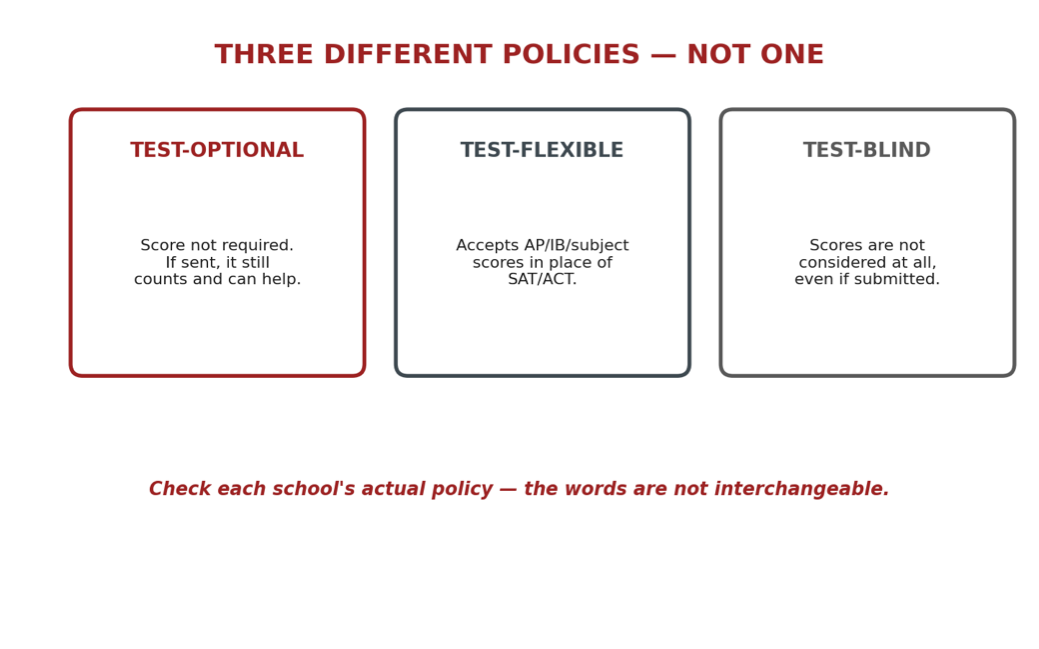
“Test-optional” means a school will consider an application without a score. It does not mean the school ignores a score if you send one. At the large majority of test-optional schools, a strong score still strengthens an application when it’s included — it’s optional to submit, not irrelevant once submitted. A genuinely test-blind school, which won’t look at scores at all even if you send them, is a much rarer category, and it’s worth knowing which one any given school on your list actually is before deciding scores don’t matter.
It’s worth spelling out a third category too, since it adds to the confusion: “test-flexible,” where a school will accept alternatives to the SAT or ACT — AP scores, IB scores, subject tests — in place of a standard test score, but still wants some form of standardized evidence. That’s different again from both test-optional and test-blind, and a school’s policy page will usually specify which of the three actually applies, even though the language across different schools’ websites isn’t always consistent about using these exact terms.
This distinction changes the calculus for a lot of students who assumed test-optional meant “skip this entirely.” If a student’s score is at or above a school’s typical admitted range, sending it is usually the right call — it’s additional positive evidence in an application that otherwise leans heavily on GPA, essays, and activities. If the score is meaningfully below that range, withholding it is the more common strategic choice at genuinely test-optional (not test-blind) schools.
Here’s a rough way to think about the decision, school by school: look up the school’s published middle-50% score range for admitted students — most publish this. If your student’s score sits in or above that range, submitting it generally helps. If it sits meaningfully below the range, most admissions offices will tell you, directly or through their own guidance, that withholding it is unlikely to hurt at a genuinely test-optional school. The judgment call gets harder in the middle of that range, and that’s exactly the situation worth a real conversation rather than a guess.
None of this is a reason to panic or to assume every school on a list needs a strong test score. It is a reason to actually look up each individual school’s real policy — test-optional, test-flexible, test-blind, and the specific score ranges they publish — rather than treating “test-optional” as one uniform category. It isn’t one. The details are exactly where the strategy lives.
Do’s and Don’ts
| DO: Look up each target school’s specific policy — test-optional, test-flexible, or test-blind — rather than assuming they’re all the same.Compare your student’s score against the school’s published middle-50% range for admitted students.Submit scores that sit at or above a school’s typical admitted range at genuinely test-optional schools.Treat scores meaningfully below the range as a real reason to consider withholding — but confirm the school is actually test-optional, not test-flexible, before assuming that applies. | DON’T: Don’t assume “test-optional” and “test-blind” are interchangeable — they’re materially different policies.Don’t skip looking up a school’s actual published score ranges before deciding whether to submit.Don’t treat every school on a list as having the same policy — check each one individually.Don’t decide not to prep for standardized tests at all based on a general impression that “most schools are test-optional now.” |
Dr. Hurwitz’ Take
I probably spend more time untangling this specific confusion than any other single admissions topic, and I don’t think it’s because families aren’t paying attention — it’s because the terminology genuinely invites the mistake. “Optional” sounds like “doesn’t matter,” and for most schools, it isn’t that at all. Getting this distinction right, school by school, is one of the highest-leverage things a family can do in the admissions process, and it costs nothing but a little bit of careful reading.
CTA: This is the kind of school-by-school detail Hurwitz Admissions works through with families directly — reach out if you want a second set of eyes on your list.