
People occasionally ask, with a note of genuine confusion, why a tenured professor spends evenings tutoring high schoolers on the SAT. It’s a fair question. The honest answer is that these two things are more connected than they look from the outside.
Years in a college classroom will teach you something that doesn’t get discussed enough outside of it: test-taking is a learnable skill, distinct from intelligence or subject mastery, and most students are never actually taught it. They’re taught content — history, math, literature — and then handed a test and expected to intuit the separate skill of taking tests well, as if it were automatic. It isn’t. I’ve watched genuinely brilliant students underperform for years because nobody ever broke down pacing, question strategy, or how to read a trap answer, and I’ve watched average students significantly outperform expectations once someone finally did.
I’ve seen this play out in my own college classroom in ways that surprised me early in my career. Students who clearly understood the material — who could explain concepts fluently in office hours — would sometimes underperform on exams relative to students with a noticeably shallower grasp of the content but a sharper sense of how to manage their time, read a question carefully, and avoid obvious traps. That gap bothered me. It suggested that a real, teachable skill was going unaddressed in the room, quietly determining outcomes almost as much as actual mastery of the material was.
That gap — between what students are taught and what they’re tested on — is what pulled me toward tutoring in the first place, and it’s the same gap I still think about in my own classroom decades later. The SAT is a smaller, more contained version of the same problem: a skill that can be explicitly taught, that almost nobody explicitly teaches.
There’s also a practical benefit to running both, one I didn’t fully anticipate when I started tutoring. Working closely, one-on-one, with a wide range of students at very different skill levels has sharpened how I explain things in the college classroom, too — tutoring forces a kind of precision and patience that’s easy to lose when lecturing to a large group. The two roles have made me better at each of them, not just occupied two separate evenings of my week.
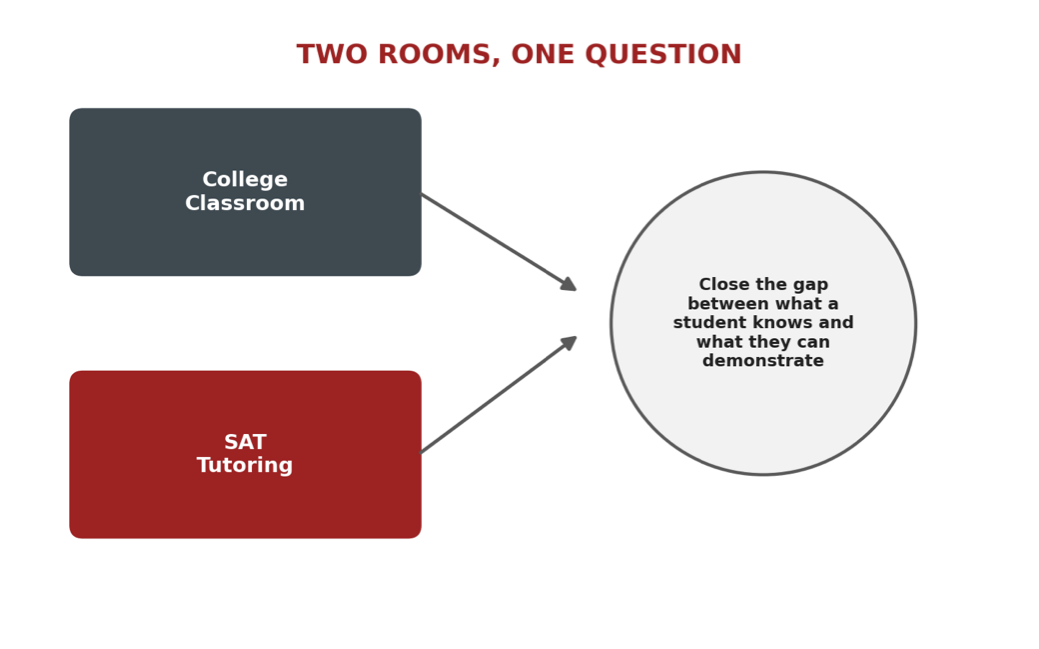
So the classroom and the tutoring aren’t really two separate things I do. They’re the same underlying interest — closing the gap between what a student knows and what they can demonstrate — applied at two different scales. I didn’t leave the classroom for this. I just found a second place to work on the same problem.
Do’s and Don’ts
| DO: Look for a tutor who treats test-taking as a distinct, teachable skill — not just a review of content already covered in school.Ask a prospective tutor how their broader teaching background informs their tutoring approach specifically.Value pacing, question strategy, and trap recognition as seriously as content review — they’re often the bigger lever.Consider that a student’s classroom grades and their test-taking skill are genuinely separate things, not the same measurement twice. | DON’T: Don’t assume strong classroom performance automatically predicts a strong standardized test score — they measure overlapping but different things.Don’t assume test-taking skill is something a student either naturally has or doesn’t — it’s teachable.Don’t discount a tutor’s classroom teaching background as irrelevant to one-on-one test prep — the two often inform each other.Don’t wait for a student to “figure out” test strategy on their own through repeated exposure alone — it’s faster and more reliable when it’s explicitly taught. |
Dr. Hurwitz’ Take
If I’m honest, the classroom and the tutoring desk scratch the exact same itch for me — watching a student go from confused to confident on something specific, and knowing I had a real, identifiable hand in that shift. The setting is different. The audience’s age is different. The underlying satisfaction is identical. I don’t think of tutoring as a side project from my “real” job. I think of it as the same job, just with more legroom to actually fix the specific thing that’s holding one particular student back.
Want to know more about the approach before your student’s first session? Happy to walk you through it — reach out anytime.