
There’s a specific facial expression every tutor develops — I’ve seen it in colleagues, and I’m sure I make it myself — that appears the instant a student opens a session with “so, I didn’t really get to studying this week.” It’s not anger. It’s closer to the look a physical therapist probably gives a patient who shows up limping and mentions, almost as an aside, that they went ahead and ran a 10K anyway.
Here’s the thing nobody says out loud enough: it’s fine. It’s genuinely fine, as long as it doesn’t become the pattern. A missed week isn’t a crisis. What matters is what we do with the session in front of us — adjust the plan, figure out what’s realistic for the coming week, and move forward without pretending the missed work didn’t happen or spiraling about it either.
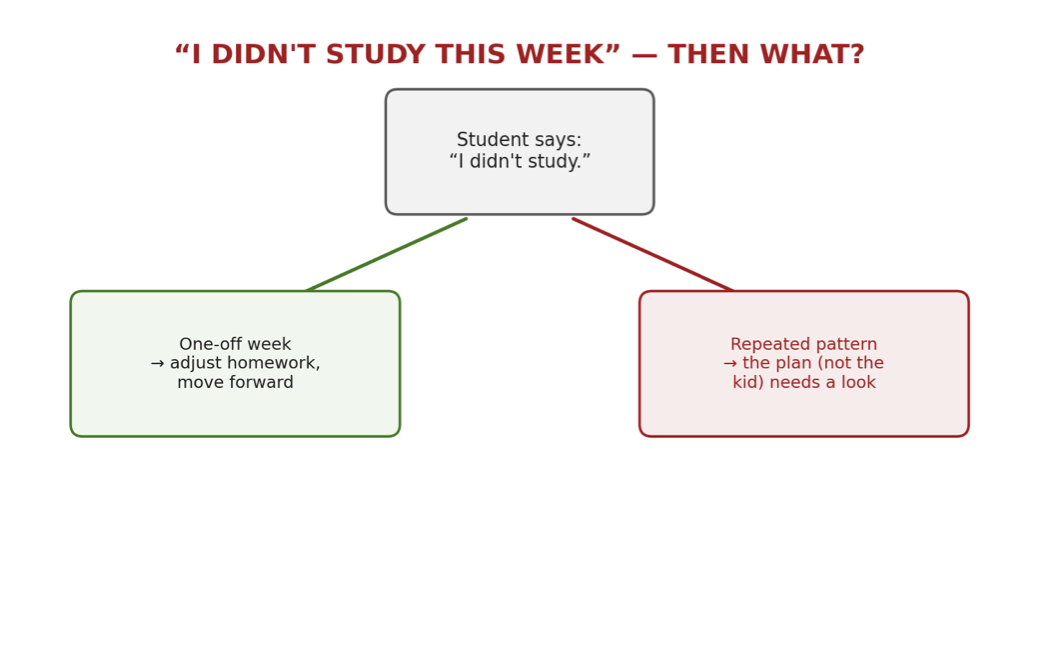
When it happens once, my internal checklist is quick and almost boring: was there a specific reason — a big exam in another class, a family event, a rough week — or was it just ordinary teenage inertia? Either way, the response is largely the same. We use the session time itself more efficiently that week, maybe trim the take-home homework down to something genuinely achievable rather than piling the missed work on top of the next assignment, and move on without making it a bigger event than it actually is.
What actually worries me isn’t the occasional “I didn’t study.” It’s the student who says it every week, because that usually isn’t about time management — it’s a signal that the plan itself has stopped feeling doable, or the motivation behind the whole project has quietly evaporated, and neither of those gets fixed by me being sterner about homework. In that situation, more pressure usually makes things worse, not better, because it treats a motivation or workload problem as a discipline problem, and those need very different fixes.
When I see the pattern repeat, the conversation I actually have isn’t with the student about effort — it’s with myself and often with the parent, about whether the plan’s between-session workload is realistic given everything else on that student’s plate, or whether something else is going on that’s worth naming directly. Sometimes the fix is a smaller, more achievable weekly homework load. Sometimes it’s a direct, gentle conversation about whether the test-prep timeline itself is creating more pressure than the family realizes.
So when a student tells me they didn’t study, I’m not doing math about wasted tutoring dollars. I’m doing a quick diagnosis: is this a one-off, ordinary teenage-life week, or is it telling me something about the plan that needs to change? Almost always, it’s the former. Occasionally, it’s useful information I wouldn’t have gotten if I’d just been irritated about it instead of curious.
Do’s and Don’ts
| DO: Treat an occasional missed study week as normal, not a crisis requiring a big reaction.Look for a pattern before concluding there’s a bigger problem — one missed week rarely means much on its own.If missed weeks become frequent, ask whether the plan’s workload is realistic rather than assuming it’s a discipline issue.Use tutoring session time efficiently to make up ground when homework wasn’t completed, rather than piling missed work onto the next week. | DON’T: Don’t treat a single missed study week as a sign that tutoring isn’t working.Don’t respond to repeated missed weeks with more pressure alone — it often makes a motivation problem worse.Don’t assume every missed week has the same cause — a one-off busy week and a pattern of avoidance need different responses.Don’t let missed homework quietly stack up unaddressed session after session. |
Dr. Hurwitz’ Take
I genuinely don’t mind the occasional “I didn’t study” — teenagers have full lives, and a missed week is rarely the disaster it feels like to the kid confessing it. What I actually pay attention to is the pattern underneath, because that tells me something real about whether the plan fits the life it’s being layered onto. The goal was never perfect compliance. It was a plan that actually works given everything else going on, and sometimes the missed week is the data point that tells me the plan needs adjusting, not the student.
If missed weeks have become the norm rather than the exception, that’s worth a conversation — not more pressure.