
Usually this comes in around six to eight weeks before a test date, from a parent who sounds slightly apologetic about asking, like they’ve already decided the answer is no and just want confirmation. Almost every time, the actual answer is no, it’s not too late — it’s just too late for a certain kind of tutoring.
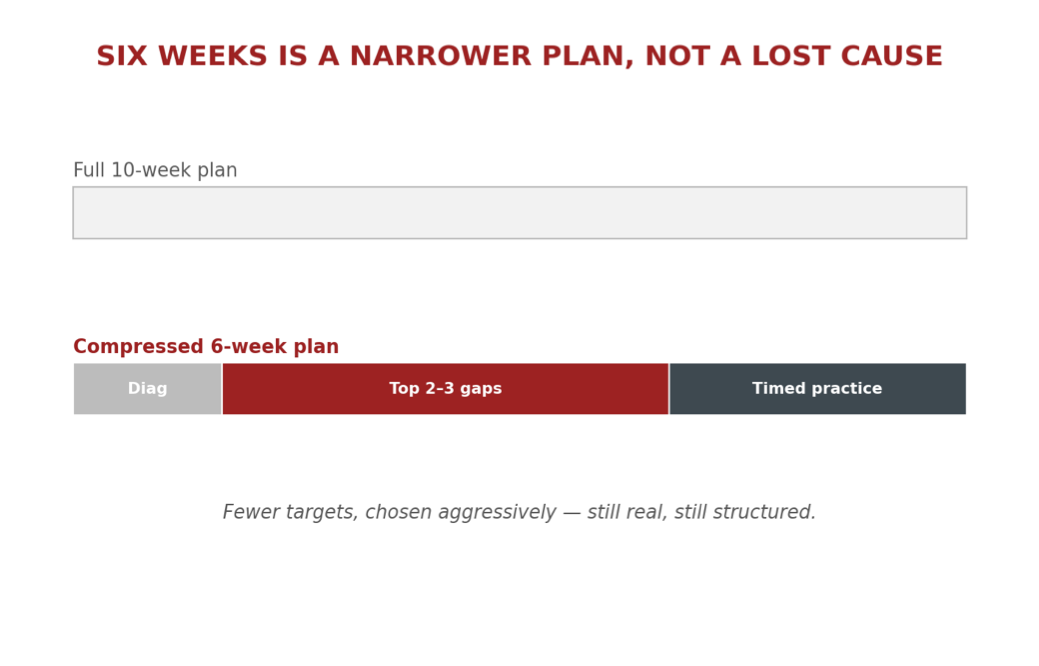
Six to eight weeks isn’t enough time for a slow, comprehensive review of every topic on the test. It is enough time for a diagnostic, a plan built around the highest-value gaps specifically, and consistent timed practice. That’s a narrower, more aggressive version of the same process I’d run with more time — and it can still move a score meaningfully, because most students’ point loss is concentrated in a handful of fixable places, not spread evenly across everything.
Here’s what a compressed timeline actually looks like in practice. Week one is diagnostic and priority-setting — no time wasted on a slow ramp-up. Weeks two through five focus tightly on the two or three highest-value gaps the diagnostic surfaced, usually meeting more than once a week if the family’s schedule allows it, since there’s less calendar to spread the work across. The final two or three weeks shift to timed, full-length practice almost exclusively. It’s a real plan, not a watered-down one — it’s just aimed at fewer targets, chosen more aggressively, because there isn’t time to also work on lower-value areas.
The honest caveat: a compressed timeline means less room for content that requires a genuinely long runway, like rebuilding foundational math skills from several years back. If a student’s gaps are that deep and that broad, six weeks isn’t going to close all of them, and I’ll say so directly, because promising a miracle nobody can deliver isn’t tutoring, it’s just marketing. In that specific situation, the honest conversation is usually about picking the two or three highest-leverage fixes rather than trying to cover everything, and being clear about what’s realistic.
But most of the “is it too late” emails aren’t that situation. They’re a student who’s fundamentally fine and unfocused, sitting on real, recoverable points that a targeted plan can reach in the time available. I’d estimate the majority of students who ask this question are closer to the “narrower version of the same process” case than the “not enough runway” case — but there’s genuinely no way to know which one applies without actually looking at where the diagnostic lands.
If you’re on the fence because you think you’ve missed the window, the better move is usually a quick diagnostic conversation before assuming the answer is no. It costs you nothing to find out, and “too late” is a much rarer answer than most parents expect.
Do’s and Don’ts
| DO: Reach out for a quick diagnostic conversation before assuming a compressed timeline is a lost cause.Expect a shorter timeline to focus on fewer, higher-value targets rather than a full comprehensive review.Ask directly whether the specific gaps are fixable in the time available — a good tutor should answer honestly, not just optimistically.Consider meeting more than once a week if the timeline is tight and the schedule allows it. | DON’T: Don’t assume six to eight weeks automatically means it’s too late — that’s rarely true.Don’t expect a compressed timeline to cover the same breadth as a full ten- or twelve-week plan.Don’t sign up with anyone who promises a large, guaranteed jump on an unrealistic timeline without seeing the diagnostic first.Don’t wait even longer to ask the question — every week that passes narrows what’s actually achievable. |
Dr. Hurwitz’ Take
I’d rather lose a client to an honest “this timeline is genuinely too tight for what you’re hoping for” than take the money and quietly know it wasn’t realistic. That conversation happens rarely, but it happens, and I think families deserve a straight answer either way. The far more common version, though, is that six to eight weeks is plenty of time to do real, meaningful work — it just requires being sharper about what to prioritize than a longer runway would.
Wondering if your timeline still works? Reach out — that conversation costs nothing and takes ten minutes.