
If I had to pick the single highest-return grammar concept on the test, it’s this one: when a sentence has a descriptive phrase set off by commas, mentally remove that phrase entirely and check whether what’s left still makes sense on its own.
That’s it. That one move resolves a surprising chunk of the Writing and Language questions, because so many wrong answers hinge on a comma-separated phrase quietly breaking the sentence’s actual grammar while sounding fine to the ear. Students get fooled because the sentence reads smoothly out loud — but “sounds right” and “is grammatically correct” are not the same test, and this trick catches the gap between them.
Try it: “The bridge, which was built in 1932, is closed for repairs.” Remove the descriptive phrase: “The bridge is closed for repairs.” Still a complete, correct sentence — so the original is fine. Now try a broken version: “The bridge, which was built in 1932, are closed for repairs.” Remove the phrase: “The bridge are closed for repairs.” That falls apart immediately, and the error is obvious once the distracting middle clause is gone. With the phrase left in, most students miss it, because their ear is busy processing three extra words of noise.
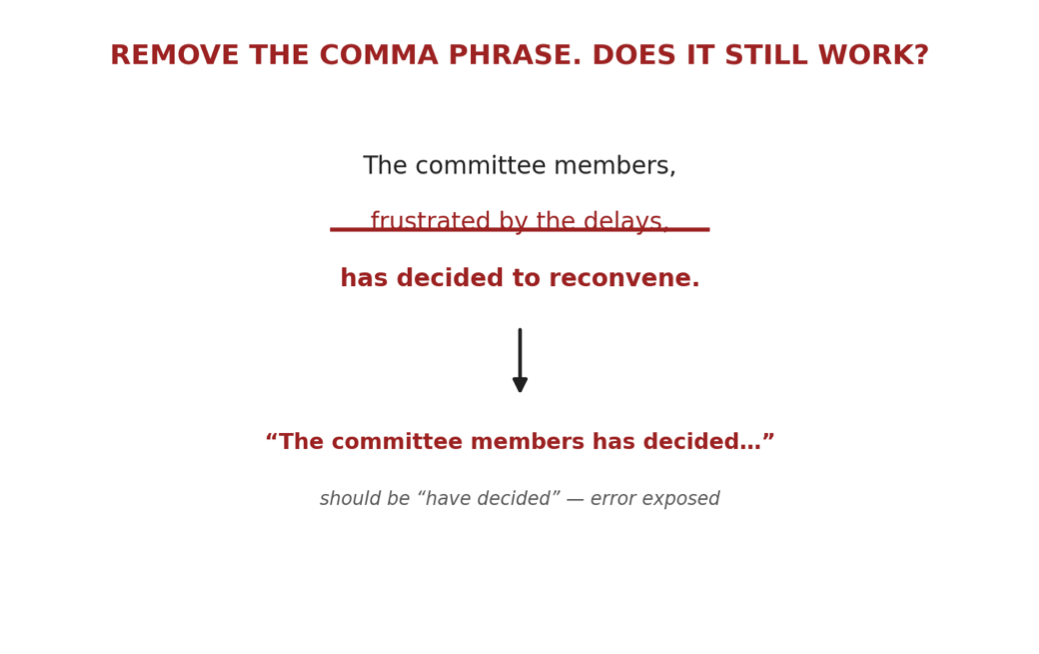
Let’s do one more, because this rule gets easier to apply the more it’s practiced. “The committee members, frustrated by the delays, has decided to reconvene next week.” Strip the comma-set-off phrase: “The committee members has decided to reconvene next week.” Immediately audible — it should be “have decided.” With “frustrated by the delays” sitting in the middle, though, a lot of students’ ears skip right past the subject-verb mismatch, because the sentence still sounds roughly conversational when read at normal speed.
This rule also has a useful second application: it works in reverse for spotting whether a comma-set-off phrase itself is even correctly punctuated, since a genuinely non-essential descriptive phrase should be removable without changing the core meaning of the sentence. If removing it changes the fundamental meaning — rather than just removing extra description — that’s a signal the commas themselves might be misused. That’s a slightly more advanced use of the same core habit, worth introducing once the basic version feels automatic.
I teach this rule in the first or second session with almost every student, because the return on five minutes of instruction is genuinely disproportionate to how many questions it touches. It won’t fix everything. But it’s the closest thing I have to a free lunch on this test, and there aren’t many of those.
Do’s and Don’ts
| DO: Mentally remove any comma-set-off descriptive phrase and check whether the remaining sentence still makes grammatical sense.Practice this specifically on subject-verb agreement questions, where the trick catches errors an ear alone would miss.Try the rule in reverse to check whether a comma-set-off phrase itself is punctuated correctly.Read grammar questions with this technique in mind as a default first move, not just as a last resort. | DON’T: Don’t rely on how a sentence “sounds” out loud as your only check — that’s exactly what this trap exploits.Don’t skip past subject-verb agreement questions just because the sentence feels long or complex.Don’t treat this as the only grammar rule worth knowing — it’s high-value, not comprehensive.Don’t forget to apply it consistently under timed conditions — it only helps if it becomes an automatic habit, not an occasional one. |
Dr. Hurwitz’ Take
Five minutes of instruction, disproportionate return — that’s rare enough in test prep that I genuinely enjoy teaching this one every single time. Most of what moves a score is slow, cumulative work across weeks. This is one of the very few exceptions: a single habit, taught once, that a student can apply correctly by the end of the same session. I wish there were ten more like it. There aren’t. This is the one.
Try this on your student’s next practice test and see how many questions it catches. Worth reporting back.