
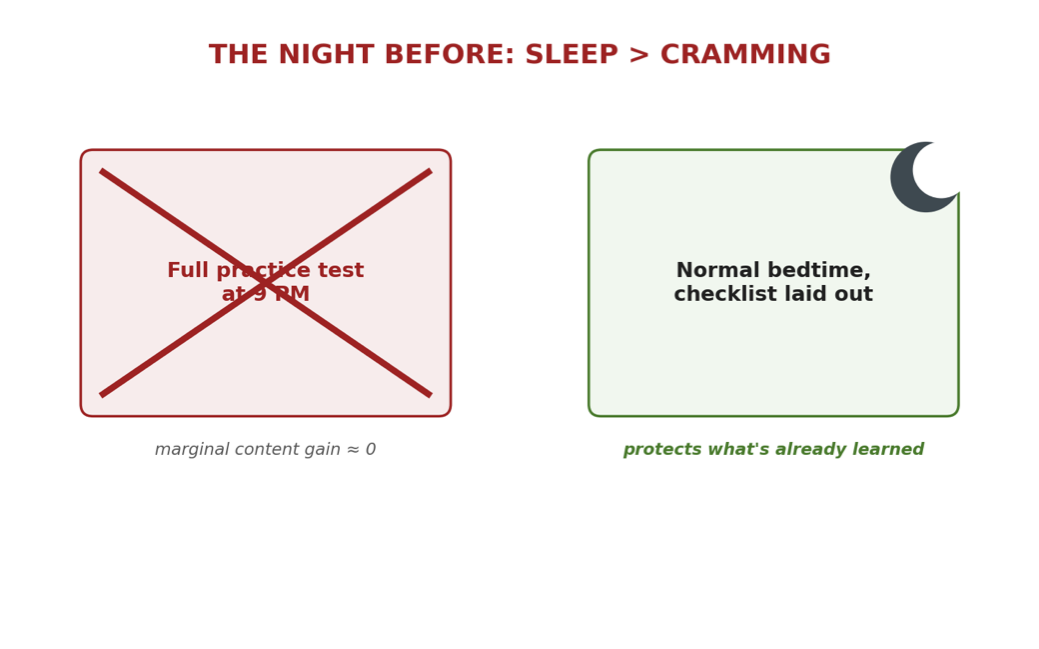
I’ll say something that runs against every instinct a stressed, well-meaning student has the night before a big test: don’t study. Not a full practice test, not a last flip through the vocab deck, not “just a little review to feel more prepared.” At that point, it doesn’t help, and there’s a real chance it hurts.
Here’s the math nobody explains. By the night before, whatever you know, you know. A few more hours of cramming aren’t going to meaningfully add to that — the marginal content gain is close to zero. What that cramming will do is cut into sleep, and sleep is one of the only variables left the night before that still has real, measurable upside on test-day performance. Trading guaranteed sleep for negligible content gains is a bad trade, every time.
It helps to think about this in terms of what’s actually still changeable the night before, versus what’s already locked in. Content knowledge accumulated over ten or twelve weeks is, at that point, essentially fixed — you’re not going to meaningfully expand it in three hours on a Friday night. Sleep, stress level, and mental clarity the next morning, on the other hand, are still very much in play, and all three of them directly affect how well existing knowledge actually gets accessed and applied under test conditions. A tired, anxious brain performs worse on material it already knows than a rested, calm one does — which means the night-before choice isn’t really “study vs. don’t study.” It’s “protect the knowledge I already have vs. risk it for a marginal gain that probably isn’t real.”
There’s also a psychological cost. A full practice test the night before often ends on a wrong answer, a confusing question, a moment of doubt — and that’s the exact feeling students carry with them to bed and then into the testing room the next morning. Confidence going into test day is not nothing. It’s worth protecting on purpose. I’ve seen students walk into a test rattled by a single tricky question they hit at 9 PM the night before, when in reality that one question had zero bearing on their actual readiness — it just happened to be the last thing they saw before trying to fall asleep.
So the actual night-before routine is almost aggressively boring: lay out everything from the checklist, eat a normal dinner, do something mildly enjoyable and non-academic, and go to bed at a normal hour. Not unusually early — going to bed dramatically earlier than normal can actually backfire, since lying awake unable to sleep creates its own frustration. Just the ordinary bedtime, protected and undisturbed.
It will feel like you’re not doing enough. That feeling is wrong, and it’s worth naming directly, because it’s the single biggest reason students override good advice and crack open a book anyway at 9 PM. By that point, the highest-leverage thing left to do is nothing at all.
Do’s and Don’ts
| DO: Lay out everything from the test-day checklist — ID, ticket, charged device, charger — before dinner, not after.Eat a normal dinner and do something ordinary and non-academic for the evening.Go to bed at your usual time, not dramatically earlier or later than normal.Trust that content knowledge accumulated over the prep period is already locked in and doesn’t need last-minute reinforcing. | DON’T: Don’t take a full practice test the night before — it risks ending on a low note that follows you into the morning.Don’t do “just a little” last-minute review — the content gain is negligible and the sleep cost isn’t.Don’t go to bed unusually early trying to “bank” extra sleep — lying awake creates its own stress.Don’t check practice scores or missed questions from earlier in the week the night before — save any review for after the test, not before. |
Dr. Hurwitz’ Take
This is the piece of advice I have the hardest time getting students to actually follow, because it feels so counterintuitive in the moment — like admitting defeat instead of pushing through. But I’ve never once seen a student meaningfully help their score by cramming the night before, and I’ve seen plenty rattle their own confidence by doing it. If there’s one instruction I want a family to actually enforce at home rather than leave up to a stressed seventeen-year-old’s judgment, it’s this one: close the books, and go to bed.
Pair this with our test-day checklist so the whole 24 hours before the SAT are covered.