
“What’s your secret?” is the question, in one form or another, that comes up in almost every first meeting with a new family. I understand the hope behind it — that there’s some proprietary trick, a clever hack, a body of specialized knowledge that separates a good tutor from a mediocre one. The honest answer disappoints people slightly every time: it’s not extra knowledge. It’s structure.
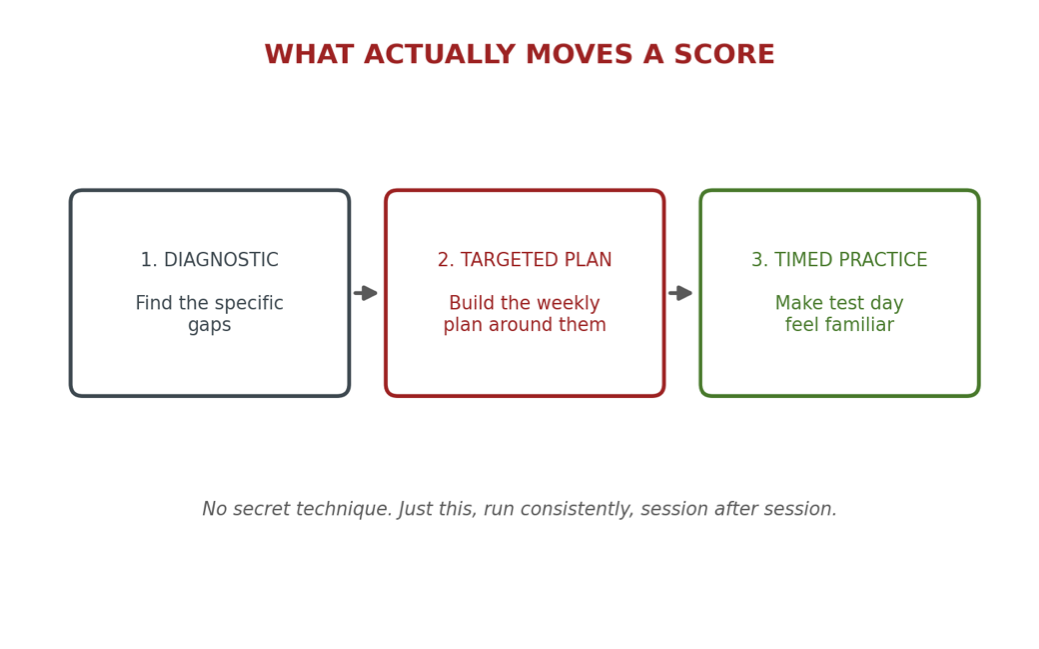
Here’s what actually moves a score: a real diagnostic that identifies specific, individual gaps instead of guessing at general weaknesses. A weekly plan built around those specific gaps, not a generic curriculum applied identically to every student regardless of what they actually need. And enough realistic, timed practice that the test itself stops being a novel, anxiety-inducing experience and starts feeling like something the student has simply done many times before.
Let me break those three pieces apart a little further, because each one is doing specific work. The diagnostic isn’t just a starting score — it’s a map of exactly which question types and skills are costing points, which is what allows the second piece, the weekly plan, to be targeted instead of generic. Without a real diagnostic, a “personalized plan” is really just a standard curriculum with a student’s name at the top of it. And the third piece, timed practice, matters because knowing a concept in isolation and applying it correctly under a ticking clock, surrounded by other questions competing for attention, are two different skills entirely — a student can master a grammar rule in a quiet drill and still miss it on a real section if they’ve never practiced applying it under actual test conditions.
None of that requires a secret. It requires discipline — mine, in building and adjusting the plan honestly session to session, and the student’s, in doing the work between sessions rather than just showing up. The tutors who get the best results aren’t the ones with the cleverest tricks. They’re the ones who run this unglamorous process consistently and don’t skip steps because a shortcut looked tempting in week four.
I’ll admit the temptation is real, on both sides. It’s genuinely tempting, as a tutor, to lean on charisma and rapport instead of the slower work of tracking specific gaps session over session — rapport feels good and is easy to sustain. And it’s tempting, as a student six weeks in, to skip a diagnostic re-check because it’s less fun than working through fresh material. The process only works if both people resist those temptations consistently, which is a less flattering explanation than “secret technique,” but it’s the true one.
I say this partly because I think families deserve an honest answer instead of a mystique-preserving one, and partly because it’s actually good news: it means results aren’t dependent on some rare, unteachable gift. They’re dependent on a process, applied consistently, adjusted based on real data. That’s boring. It’s also why it works.
Do’s and Don’ts
| DO: Insist on a real diagnostic before accepting any “personalized” study plan from a tutor.Expect the weekly plan to reference specific, named skills rather than generic topic review.Build in regular timed, realistic practice — not just isolated concept drills.Ask how progress will be tracked and adjusted session to session, not just assumed. | DON’T: Don’t be swayed by a tutor’s charisma or credentials alone without asking about their actual process.Don’t accept a generic, one-size-fits-all curriculum marketed as “personalized.”Don’t skip periodic diagnostic re-checks just because they’re less engaging than fresh material.Don’t expect results without consistent, structured effort on both sides — tutor and student. |
Dr. Hurwitz’ Take
If a family walks away from a first meeting slightly underwhelmed that I don’t have a secret to reveal, I actually take that as a good sign — it usually means they were paying close attention rather than looking for a magic word. The families who do best with this process are the ones who come to trust the boring version: diagnose, target, practice, repeat, adjust. It’s not a pitch. It’s just what I’ve watched actually work, consistently, for as long as I’ve been doing this.
Want to see this process applied to your student specifically? Let’s start with a diagnostic.