
When people hear that a student’s score jumped 240 points, they assume that’s the win. For the student, sure. But when I talk to the parent afterward, the number is rarely what comes up first.
What comes up first is: “I actually knew what was happening every week.”
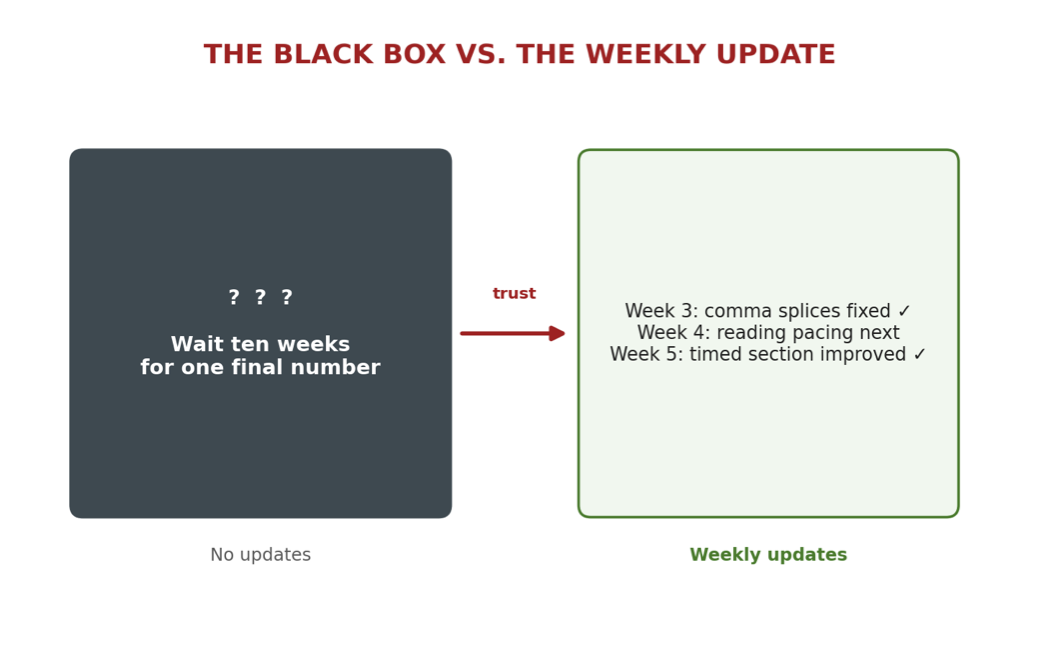
That’s it. That’s the whole revelation. Not a secret pedagogy, not a proprietary curriculum — just knowing, session by session, whether the plan was working, instead of wondering silently for ten weeks and finding out at the end whether the money was well spent.
I get it. Tutoring can feel like a black box from the parent’s chair. You’re paying for something happening behind a closed door (or these days, a Zoom window), and the only real feedback loop most families get is a single number at the very end. That’s a strange way to run something you’re investing real money and your kid’s time into, and it’s honestly a strange way for me to run a business, too — I wouldn’t want to hand a mechanic my car for ten weeks and get a single word back at the end, so I don’t ask parents to do the equivalent with their kid’s prep.
So I send weekly updates. Not vague ones — actual notes on what we covered, what clicked, what didn’t, and what we’re doing next. A typical one might say something like: “This week we worked on comma-splice questions and timed reading passages. [Student] is now getting the comma questions right consistently but is still rushing the last reading passage — we’re going to build in a pacing drill next week specifically for that.” That’s a sentence a parent can actually use. It tells you what happened, what’s still a problem, and what’s being done about it.
Parents don’t need to understand the difference between a dangling modifier and a misplaced one. They need to know their kid is moving forward and exactly how I know that. I’ve found that the more specific the update, the more it does for a family’s peace of mind — “going well” reassures no one, but “here’s the exact thing we fixed this week and the exact thing we’re fixing next” reassures almost everyone, because it reads like evidence instead of a sales pitch.
It turns out that transparency is worth almost as much as the tutoring itself. Families relax. They stop hovering, stop asking their kid anxious dinner-table questions, and let the process work — because they can see it working in real time instead of hoping it is. I’ve had parents tell me the weekly note became the thing they looked forward to more than the eventual score report, because it was the thing that actually reduced their week-to-week anxiety, in real time, instead of just resolving it once at the very end.
If you’re evaluating tutors right now, ask this one question before anything else: “How will I know it’s working before the final score comes back?” The answer tells you more than any list of credentials will. If the answer is vague — “I’ll let you know if there are any concerns” — that’s worth noticing. If the answer is a specific weekly artifact you’ll actually receive, that’s a very different kind of commitment, and it’s the kind worth paying for.
Do’s and Don’ts
| DO: Ask any prospective tutor exactly how and how often they’ll communicate progress — get a specific answer, not a vague reassurance.Expect updates to name specific skills, not just “going well” or “making progress.”Use weekly updates to guide dinner-table conversation instead of open-ended “how’s studying going” questions.Save the updates — they’re a useful record if you ever need to reassess the plan mid-cycle. | DON’T: Don’t accept “no news is good news” as an update policy from a tutor.Don’t wait until the final score to find out whether the money was well spent.Don’t mistake a vague, feel-good update for a specific, useful one — they read very differently once you know what to look for.Don’t let anxious daily check-ins with your kid substitute for a structured weekly update from the tutor — it puts pressure in the wrong place. |
Dr. Hurwitz’ Take
If I had to name the one habit that’s done the most for client retention over the years, it isn’t a teaching technique. It’s the weekly email. It costs me maybe ten minutes a student, and it consistently turns out to be the single thing families mention first when they talk about why the process felt trustworthy. I’d go so far as to say a tutor who can’t or won’t do this regularly is telling you something about how the rest of the process is probably being run, too.
Want to see what a weekly update actually looks like? Ask and I’ll send a sample.