
Reading comprehension questions have a specific, sneaky failure mode that trips up strong readers more than weak ones, which is counterintuitive until you see it happen. The trap isn’t a false statement. It’s a true statement that just doesn’t answer the actual question that was asked.
Here’s how it plays out. The passage says something true — supported, accurate, right there in the text. An answer choice restates that true thing almost word for word, and a student who’s been carefully reading for accuracy pattern-matches to it immediately, because it is, in fact, accurate. The problem is the question wasn’t asking “what’s true in this passage.” It was asking something more specific — what’s the author’s purpose, what does this word imply in context, what does the passage suggest but not directly state — and the true-but-irrelevant answer doesn’t actually address that.
Strong readers fall for this constantly, because their instinct is to verify accuracy, and this trap is specifically engineered to satisfy that instinct while missing the point.
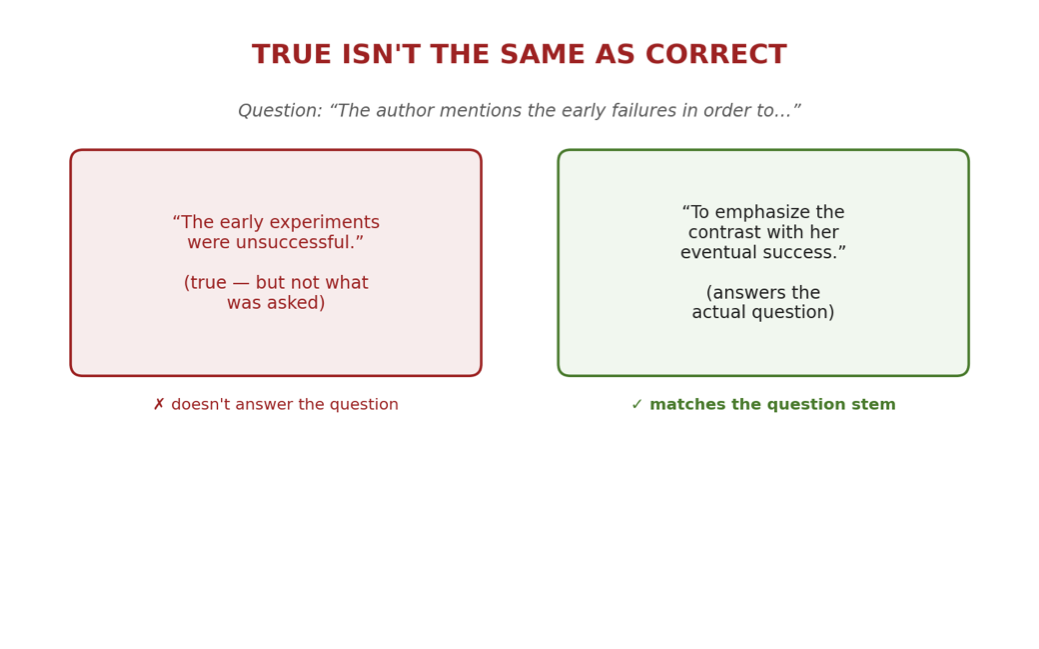
Here’s a concrete version of it. Suppose a passage describes a scientist’s early failed experiments and then her eventual breakthrough, and the question asks: “The author most likely mentions the early failed experiments in order to…” A trap answer might read something close to, “show that the scientist’s early work was unsuccessful” — which is true, word for word supported by the passage. But that’s not what the question asked. The question asked about the author’s purpose in including that detail, which is almost certainly to emphasize the contrast with the eventual success, or to illustrate persistence, not simply to report that early attempts failed. The trap answer describes a fact from the passage; the correct answer describes why that fact is there.
This is exactly why re-reading the question stem matters as much as re-reading the passage. Students spend enormous energy making sure they’ve understood the passage correctly and comparatively little energy making sure they’ve understood what the question is actually asking. Both matter, but the second one is where this particular trap lives, and it’s the one that gets skipped under time pressure.
The fix is a small habit shift: before selecting an answer, reread the actual question stem one more time and ask, does this choice answer that specific question, not just “is this true.” It sounds almost too simple to matter, and yet it’s one of the most reliable fixes I’ve seen for students who are strong readers but plateau below their comprehension ability would predict. The passage was never the hard part for these students. The question was.
Do’s and Don’ts
| DO: Reread the exact question stem right before selecting an answer, not just once at the start of the question.Ask specifically whether an answer choice addresses what the question asked, not just whether it’s factually accurate.Pay particular attention on “author’s purpose” and “implies/suggests” style questions, where this trap is most common.Practice identifying trap answers explicitly during review, not just noting whether the final answer was right or wrong. | DON’T: Don’t select an answer choice just because it’s a true statement supported by the passage.Don’t assume strong overall reading comprehension makes this trap irrelevant — it often fools stronger readers more.Don’t skip rereading the question stem to save time — it’s usually faster than second-guessing an answer later.Don’t treat a missed question of this type as a comprehension failure — it’s usually a question-reading habit, which is a much faster fix. |
Dr. Hurwitz’ Take
This is one of the more counterintuitive things I tell parents, and I can usually see the moment of surprise on their face: your kid being a genuinely strong reader doesn’t protect against this trap. It can actually make it worse, because a strong reader trusts their own accurate recall of the passage and stops double-checking it against the actual question. The fix isn’t more reading practice. It’s a very specific, very small habit — reread the question — that takes about a week to make automatic and then just quietly stops costing points.
If your student is a strong reader with a flat reading score, this is usually the reason. Contact me directly or comment PLAN for the free study plan that trains this habit.: