
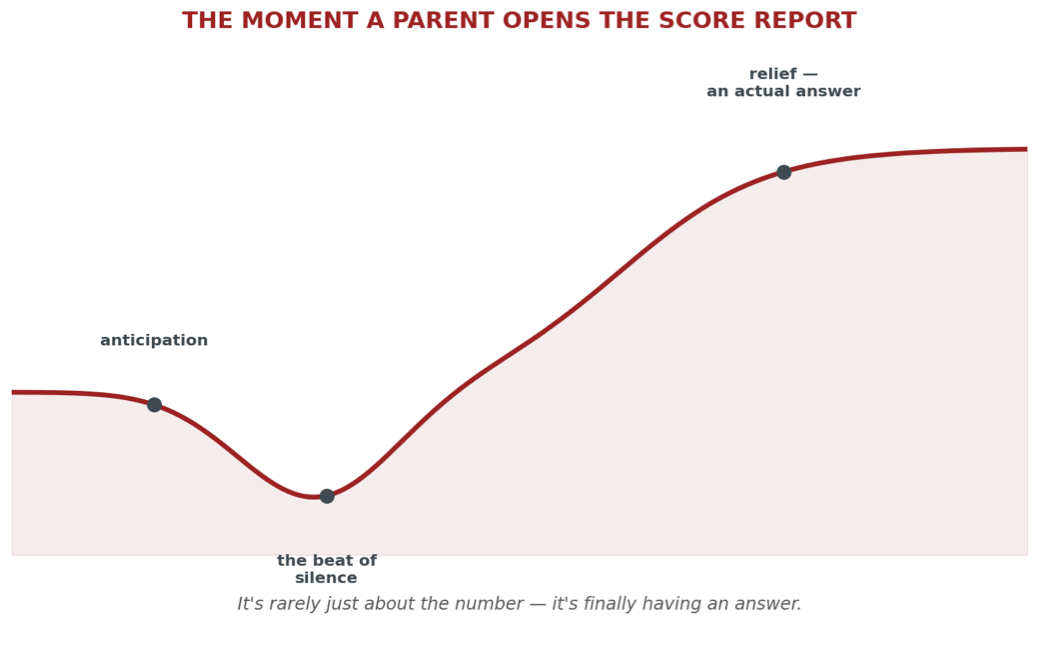
I’ve watched this reaction enough times now to say there’s a pattern to it, and it rarely goes the way either the parent or the student expects going in.
First there’s a beat of silence — the parent scanning the number, doing rapid mental math against whatever benchmark they’d quietly set for themselves. Then, more often than not, something a little unexpected happens: the relief isn’t really about the number itself. It’s about finally having an answer. Weeks of not-quite-knowing whether any of this was working resolve into an actual fact, and that resolution feels good almost independent of what the fact turns out to be.
Which is not to say the number doesn’t matter — it does, plenty. But I’ve had parents get emotional over increases that, on paper, were modest, because the increase confirmed that the process had integrity, that their kid had genuinely put in effort and it had genuinely paid off in a way they could finally point to and believe.
I think what’s actually happening in that moment is that the score report is standing in for a much bigger question the family has been carrying, mostly unspoken, for weeks: “was this worth it — the money, the time, the extra thing added to an already full schedule?” The number on the page is really just the most visible proxy for that larger question, which is why the emotional reaction can feel disproportionate to the raw point increase. It’s not really about the fifty or eighty or two hundred points. It’s about everything those points represent.
The flip side is also true, and worth naming honestly: a smaller-than-hoped increase is a real disappointment, and I don’t try to talk families out of feeling that. What I do instead is look at it alongside them — where specifically the points did and didn’t move, what that tells us, and whether there’s a clear next step worth taking. Sometimes that conversation turns up something specific and fixable — a section that was rushed on test day due to nerves, a topic that needs one more focused pass — and sometimes it confirms that the score is close to where it realistically should be, which is its own kind of useful, if less exciting, information.
A single score report is a data point, not a verdict. Treating it as the final word, in either direction, tends to obscure the more useful question underneath it: what do we actually know now that we didn’t before?
Do’s and Don’ts
| DO: Look at a score report as one data point in an ongoing process, not a final verdict on effort or ability.If the increase is smaller than hoped, look specifically at where points did and didn’t move before deciding on next steps.Give real credit to the process itself, separate from the exact number — effort and integrity of the plan matter too.Use the score report as the start of a conversation about next steps, not the end of one. | DON’T: Don’t treat a single score report as the definitive final word on a student’s ability or a plan’s effectiveness.Don’t let disappointment over a modest increase erase the real progress that may have happened underneath the surface number.Don’t skip the follow-up conversation about where points did and didn’t move — that’s where the useful information actually is.Don’t assume a strong number means the process is finished if there’s still a test date ahead to plan for. |
Dr. Hurwitz’ Take
I’ve come to think the score report reveals almost as much about the family as it does about the student — what they were hoping for, what they were quietly bracing for, what “worth it” actually meant to them going in. My job in that moment isn’t just to explain the number. It’s to help translate it into something useful, whatever it turns out to be: — a reason to celebrate, a reason to adjust, or, most often, a bit of both at once.
Whatever the number says, there’s always a next step worth mapping out. Reach out, and we’ll look at it together.